The Service
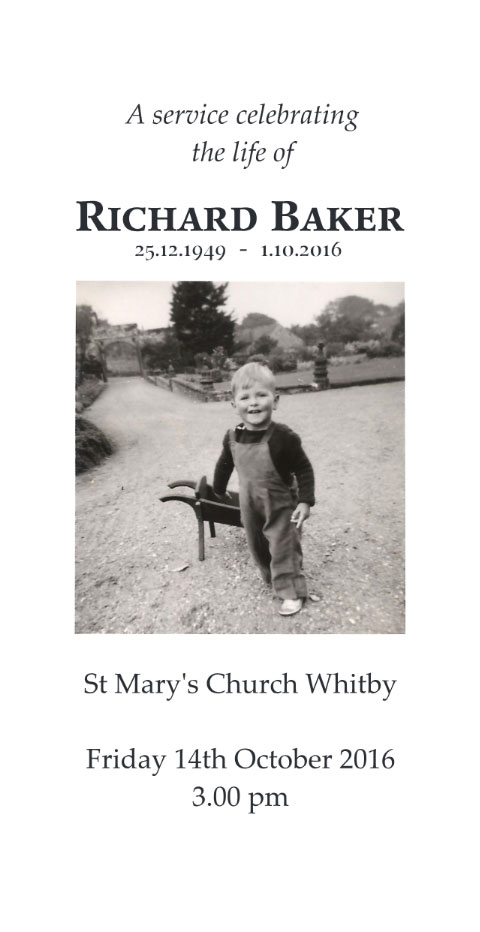
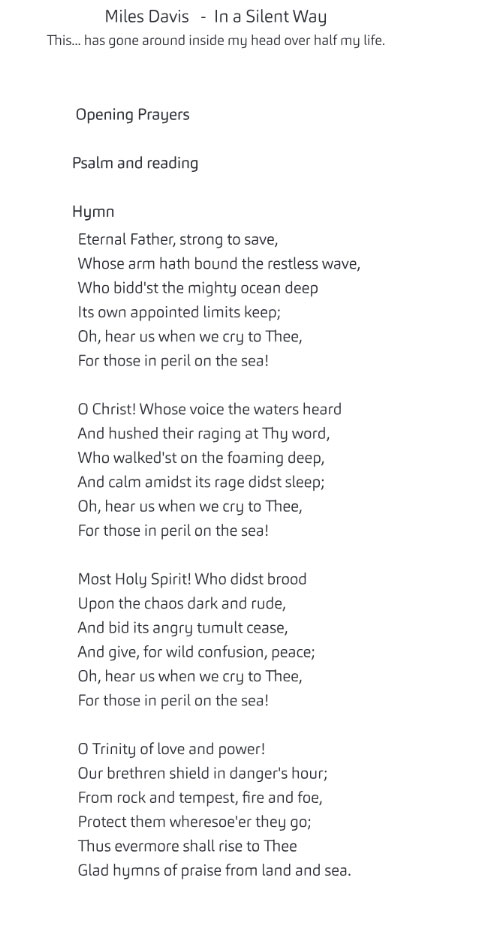
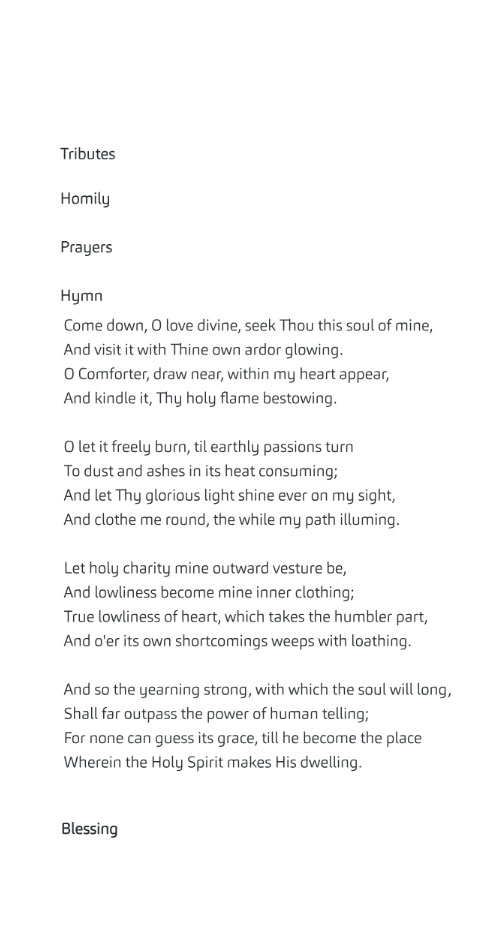
The Service Sheet

The Tributes
"When Earth's Last Picture is Painted"
Peter Budd
Pete Budd was a crew mate when Richard sailed on the Endeavour from Whitby to Norway. As a Whitby character he later became a close friend of whom Richard said he wished he had met Pete earlier in his life. During the final days of his illness Pete visited and read poems and extracts from the Cook journals. One of the poems, he shared in the tributes at the service.
Rudyard Kipling
“When Earth’s Last Picture is Painted”
1892 (L’Envon to “The Seven Seas”)
When Earth’s last Picture is painted and the tubes are twisted and dried,
When the oldest colours have faded. And the youngest critic has dried,
We shall rest, and, faith, we shall need it – lie down for an aeon or two
Till the Master of All Good Workmen shall put us to work anew.
And those that were good shall be happy: they shall sit in a golden chair;
They shall splash at a ten-league canvas with brushes of comets’ hair
They shall find real saints to draw from – Magdalene, Peter and Paul;
They shall work for an age at sitting and never be tired at all!
And only The Master shall praise us, and only The Master shall blame;
And no one shall work for money, and no one shall work for fame,
But each for the joy of the working, and each, in his separate star,
Shall draw the Thing as he sees It for the God of Things as They are!
The Young Richard
Edward Mayer
I met Richard in 1969. Another time, another world. The Beatles had broken up, Man had reached the Moon, and everything about us was
changing so very fast. The Summer of Love was long gone, Flower Power was on the wane, our innocence was vanishing round a dark
corner. Vietnam was raging, Northern Ireland was getting very nasty indeed, and we were about to enter an era of political decline and
massive inflation like nothing we had experienced before.
I was a long-haired third year student, studying English and Art History, with no idea at all of what to do next. I met Richard through
a new friend, Dennis Rix, who together with me ran the University film society. Like me, Richard wore old military jackets. But his came
from his father, a naval officer, which made some difference as mine came from the army surplus shop down by the railway station. But it
gave us something to chat about when we first met.
How can I describe Richard best? Remember that I am now a naturalist who loves most living creatures! Richard was like an
electric eel, tall, thin, glossy, handsome, utterly charming, beautifully spoken, but carrying a charge in his sparkling wit that could stop you
in your tracks. I have never met anyone so wonderfully innocent on the outside, so sharply and accurately intelligent on the inside.
He could not be fooled. He could see the world and the people in it for what they were. His intolerance of humbug, lazy thinking and
mindless conformism was absolute. But instead of ranting on like so many others he would analyse and explain his thinking to you. That’s
what made him unique.
He introduced me to new worlds. In music, folk rock, Sandy Denny, Fairport Convention and Steel Eye Span. To his family, out there in
the misty East Anglian fens surrounded by dogs and cats and ducks and geese and pheasants, all of us sitting in the kitchen peeling
potatoes while the livestock fought around us on the floor.
We both moved to London, me to work in a succession of grey offices, Richard to adorn the streets busking. My wife Mandy has a
wonderful memory of Richard then, coming across him by chance at Oxford Circus one dark winter’s afternoon, amidst immense crowds
of commuters hurrying home. Richard, carrying a well worn guitar, dressed in a ragged flowing costume of many colours, capped with a
top hat, shouting out a greeting that stopped the traffic dead, sweeping her off her feet in a giant bear hug as all around the grey crowds gawped.
That’s the way to do it!
Our Big Brother
Philip Baker
Richard is our big brother – not just in stature -, he is the head of our mixed 5 a side football team (sometimes, when we were children we were a 6 a side team when the dog participated). But Richard’s family didn’t stop within the name of Baker, as he generally made people feel like he was their brother too, in the sense of family and in the wider sense of brotherhood.
Richard’s protective nature was apparent very early on to his siblings, - from saving one of us from a particularly trying prep session at school, to stopping a man abusing my very heavily pregnant sister at my wedding, with nothing but a few words, which meant that this man preferred risking playing with traffic, rather than getting any more words from Richard.
Memories of Richard must not be defined by his disease, I am sure that he would want a tiny part of his legacy to be ‘look after yourselves’, if you feel that there is a problem, pursue medical attention promptly.
Five years ago, on the death of our remaining parent, Richard was determined to hold the family together, which was no small task, with us five very disparate siblings, living quite significant miles apart, but he has got us all talking more often. We appreciate this Richard.
I always remember that after Richard left home, his return for a visit was something to look forward to , he always brightened up the place, as it turns out he did that for everyone.
Today we are here to celebrate his life, so, as he brightened up all our lives, go out from here and pay forward Richard’s gift to us.
Richard, The Sailor
Sinclair Molloy
Good afternoon,
My name is Sinclair and my youngest son was named after Richard. We first met in Belfast in the mid seventies when Richard visited Doff who was working on a community arts project. Many years later, I remember talking to Richard in Stockton on Tees, over a cup of tea, about the first Tall Ships Festival on the Tyne. Richard surprised me by telling me that he had already undertaken a tall ship voyage aboard the Sail Training Ship, Sir Winston Churchill. When he described his experience, I wasn't sure why he planned to do it again, or why he was so keen for his next voyage to be with one of the Jubilee Sailing Trust's brigs; I was thinking about the problems he might experience; 50 strangers in a very claustrophobic space, regimentation, shouted orders, orders that made no sense, not knowing what to do, being too tall,
( those bunks and hammocks were way too short for Richard)
sea sickness, fear, loss of autonomy, loss of privacy, sleep deprivation, damp, cold, …..”loud people” ……..“know it all” ship mates ………..... and “fools.”
....
.......I just couldn't picture Richard enjoying this. But of course the mission of the Jubilee Sailing Trust is to integrate physically disabled and able bodied people, helping them to discover their abilities .....and to focus on what they can do, ...... rather than what they cannot do ..... focusing on what we can do, rather than what we can’t do …this was of course just right for Richard.
It wasn't long before Richard had persuaded me to take my first voyage on a tall ship and I was able to fully appreciate his enthusiasm. Yes, it was something to do with Moby Dick .......and a sea voyage being exactly the right antidote to "growing grim at the mouth" or a "damp, drizzly November in the soul”.
However, it was also about fabulous voyages described by enthusiastic primary school teachers, Daniel Defoe and Robert Louis Stevenson. Childhood voyages on Union Castle liners, Columbus, Captain Cook and the whalers and explorers of yore.
The original Endeavour captained by Lieutenant James Cook, set off from Whitby in 1768. When Richard first saw the replica Endeavour in Plymouth in 1997, he immediately made up his mind that he would one day sail on her and he set about gaining experience on sail training vessels. Doff described his discovery of the Endeavour as being like "watching her husband fall in love with another woman." Richard said that stepping aboard the first time, ”felt like being a little boy, trying to behave, on the night before Christmas.” He also described being on watch in the early hours of the morning as being like "sailing to heaven".
In 2004, Richard persuaded me to join him on an Endeavour voyage, from Whitby to Norway, and I saw how the pressures of sharing a tight space with 50 other people in 18th Century conditions, in bad weather "smashed habits” as Richard put it, encouraging both "camaraderie and contemplation".
I saw how this very private man, so gentle and encouraging, so quietly enthusiastic, whether handing sail aloft, or washing dishes in the galley, always gave of his best. Richard was always interested in his ship mates, always keen to share his knowledge of seamanship and history.
With his special laugh and his interest in all of his shipmates Richard was the best of ship mates, just as he was on land.
I count myself very privileged to have known Richard, both on land and on the sea.
Richard, The Writer
Ant Smith
Richard, was a great writer.
I wanted to ensure those were my very first words to you as I wanted this simple truth to be the one thing that my few minutes impresses into our hearts; that Richard, was a great writer.
Most simply, his writing was great – to look at. I don’t know if he was using a felt tip pen when he wrote his letters to me but I well remember how that particular flowing script of his jumped out when an envelope came through my door. Instantly recognisable as not a bill! But rather a guarantee of a good read. Just the sight of such a letter could lift my mood because Richard always wrote the best of letters. It may seem small and trivial, but when a person’s writing can change your mood, be it a letter, or a timesheet composed in poetry, it IS a sign of great writing.
But don’t mistake me, his writing was by no means purely trivial. He did not get the big book deal or the Hollywood movie script – but these things are not the measure of great writing. They are the measure of a world that fails to appreciate the special people that are upon it. This missed appreciation is the world’s loss, not Richard’s; and thankfully not ours.
Because we can continue to enjoy his legacy. And Richard wrote for enjoyment. He well understood the power of writing, to help us make sense of things but he knew that power needed taming, tethering to our daily lives, to real ourselves. He once told me he did not understand fantasy writing and on reflection that makes so much sense. His plays would often deal with real, historical people; imbued with fully rounded characters. It was palpable that he cared deeply for his characters, that they should have a real and meaningful existence. Richard excelled in his characterisation, as exemplified by his play Tommy On The Bridge. He excelled with his characters in exactly the same way that he excelled in his real world love, respect and tolerance for people.
Reading possibly his favourite poem, that which was closest to him as his journey in this world was nearing its end, Andrew Marvell’s “To His Coy Mistress” I am struck by one specific line:
“Nor would I love at lower rate”
And nor would he. The love that Richard generated in this world he also poured into his words and it is this that makes his writing great. Richard was a great writer because Richard was a great man.
I think he would be horrified that I say so. When sending me drafts he would start to make excuses then say “I’ll save my usual author type worries until after you’ve read it”. This, if it were needed, is the ultimate proof of greatness. His humility and insecurity, the fact he did not know he was as good as was.
These are the last words from his diary:
We will lose little things too easily
Spare change, our keys, addresses, plus
Those useful things we keep somewhere until we fail
To find them when they might be most useful
Where do they go what secret do they possess
That they must waste our time by hiding?
In what more beautiful, poignant way, could he exhort us to get on with our lives? To the last, filling his words with love and care for others.
He could not love at a lower rate – it was impossible for him.
Richard and The Captain Cook Museum
Richard and The Captain Cook Museum
Peter Brown
On behalf of everyone at the Captain Cook Museum, we present this tribute to Richard. Sophie is extremely sorry that she was unable to be here today but had to be in London on museum business, but she joins us in remembering and paying this tribute to Richard’s work at the Museum.
Richard joined us in 2006 as a Volunteer. He was modest and retiring to begin with, but could not hide his light under a bushel for long! Always helpful, he was happy to do anything – whether heaving large exhibits and sheets of glass for the cases in the attic, looking up passages in Captain Cook’s journals, or doing the cleaning when we needed someone. He loved dusting models with a paintbrush, even a full-size Maori canoe prow which stood almost the breadth of the Orientation Room and took nearly an hour! He once offered to meet a Japanese visitor off the bus on his arrival in Whitby, and ended up spending the evening showing him round the town and sharing a meal! That Japanese visitor subsequently became a Patron and always saw Richard on subsequent visits. Richard was rapidly recruited onto the Education Team where he delighted children with his knowledge and enthusiasm, his deep love of the sea, and his experiences on the replica Bark Endeavour.
But perhaps most of all, we will remember his as one of our most delightful receptionists. Before starting his work for the day he could be often seen stood by the harbour wall in the courtyardquietly contemplating what he considered one of his favourite views of Whitby. Here he really came into his own! We think of him standing behind the desk, sporting a colourful and elegant waistcoat – he had a wonderful variety of waistcoats – tall and thin, gesticulating with expressive hands, as he charmed visitors with his enthusiastic welcome and introduction. What a wonderful way to start a visit!
Wherever he was, there was laughter and good humour. His enviable charm was combined with kindness and gentleness, a true gentleman in life and a treasured memory in death. We thank you, Richard, for everything you did for the Museum. Goodbye old friend, we shall miss you.
Skinningrover
Adrian Hill
I am Adrian Hill Chairman of the Skinningrove Bonfire Committee. The following has been prepared jointly by Doff and Geoff Robinson
To be accepted and allowed to feel like one of the family, for an outsider, in Skinningrove is a hard won accolade. Richard has been taken into the hearts and homes of people in the village. It did not come quickly or easily but there is something about Grovers that Richard took to and completely respected for over a generation. The feeling appears to be mutual.
Richard was humbled by the village for letting him come to the beach and by hook , crook, challenge, unexpected turns and adventures create a bonfire with Grovers support and input to be burnt on Nov 5th.
He had been creative in lots of forms and had become tired of “the artist” and here in Skinningrove he found men, youths, women and children with no pretensions to artistry but the ability to pick up a hammer, a paintbrush or a withy and effortlessly turn innate things into magical constructions large and small. He understood the inherent Skinningrove ability to build and he channelled it into the bonfire. As one young woman said “the Bonfire gives us Grovers something we can be really proud of”.
Someone has to be in charge to manage the creation of a beautiful structure and Richard managed to do that effortlessly by leading without commanding.
He was calm in all situations:
No wood - too much wood
No people - too many people
People nicking wood - people asking for some
He dealt with it in his own way
He could draw things out of people, without them knowing they had it inside them, getting the best from them
He did not force anything on people.
He had a knowledge of the importance of the human spirit and that each brings what they have to the job
He could stand next to them in the pub and then get them to work in the morning
He moulded the bonfire building weeks into an institution.
He never judged or took sides
He stayed out of the fights
He did not moan and had no self pity
People respected and accepted him, they did not understand him but they did not need to they took him as they found him with no pretensions. He earned the Grovers respect
Richard’s strength lies in his individuality, his genuine warmth and the power of his character.
When he did not know what to do he would go to see Geoff and whiling away the 5 minutes into 3 hours over mugs of tea and biscuits they would explore the options and find a solution. While men of very different backgrounds and experience they had a sincere and mutually valued bond between them.
Richard could not have built the bonfire without the people of Skinningrove but what he has taught them means they will now be able to go forward using what they have learnt from him to do it for themselves.
He was touched by the many messages and cards he received from people while he was ill particularly confirming in so many different ways his place in the village as a Grover
The Final Send Off
His ashes were in the firebox of the bonfire so this almost full size Endeavour like ship which, looks so much like a model next to the fireworks on the Christmas card, provided a final send off. A minutes silence was held at the start of the firework display.
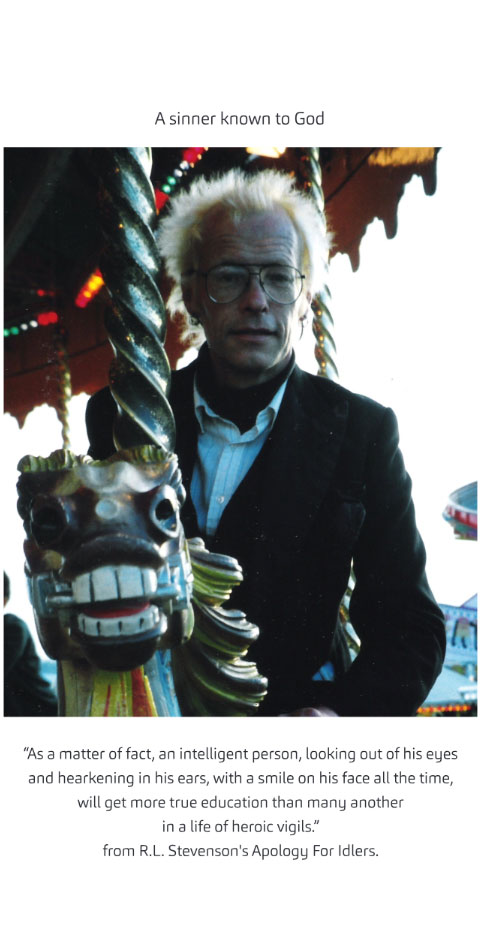
Life is a precious gift we should enjoy and live fully, enabling us, when we are left to still experience our treasured memories. On his funeral sheet Richard asked that it should say “ A sinner known to God” and I thank God for his life.
Doff
The Service
This is sample content, you can replace it with your own text and images.